Once the recovery pump stops, the entire three-stage oil and gas recovery system shuts down - there is no outlet for the oil and gas in the tank area, and the oil unloading and loading operations are subsequently restricted. Therefore, "whether to equip with two pumps" is an unavoidable issue during the equipment configuration stage: a single pump saves money and space, but if the pump fails, every day from the time of reporting the repair to the time of recovery is a bare run; equipping with two pumps costs an additional amount of money, but in exchange, one pump can be replaced with the other, ensuring uninterrupted operations. There is no standard answer to whether to equip or how to equip, but there is a clear approach to follow: look at the operational intensity of the site, the cost of downtime, and the operation and maintenance conditions. This article clarifies the approach and implementation of redundant dual-pump configuration.
What problem does dual-pump redundancy solve
The value of dual pumps is most prominent in three scenarios. First, stations with high operational intensity: peak oil loading and unloading, long-term high-load recycling systems, rapid pump wear, and naturally higher failure rates. Second, scenarios where downtime costs are high: when the loading of oil depots and the recycling systems of large stations are shut down, the loss of operational constraints far exceeds the cost of one pump. Third, stations with limited operation and maintenance conditions: located in remote areas, where maintenance forces arrive slowly, dual pumps provide a buffer time for themselves. Conversely, for stations with low operational volume and fast manufacturer response, a single pump combined with a rapid maintenance commitment may also be a more economical combination. The core is to calculate: by comparing the "loss of one day of downtime" and the "incremental investment of dual pumps", the answer often becomes clear.
Five key points for implementing a dual-pump configuration
- The capacity of each individual pump must be guaranteed: redundancy is based on the premise that any single pump can independently withstand the design operating conditions. The arrangement of using two small pumps to make up for peak demand will still leave one at a loss in case of failure;
- Clarify the switching method: automatic switching is convenient but the control loop is complex; manual switching is simple and reliable but relies on people. Choose based on the operation and maintenance level of the site, and don't blindly adopt automatic switching;
- Isolation for maintenance should be convenient: each pump should have independent valves at its inlet and outlet, so that if one pump malfunctions, it can be isolated for repair without draining the entire system;
- Incorporate rotation operation into procedures: If only one pump is operated for a long period, the standby pump may become rusted and jammed. Regular rotation between the two pumps ensures that the "standby" pump is always ready for use;
- Don't overlook the linkage control: The start and stop of the pump, system interlocking, and fault alarms should be monitored by the duty personnel. If the pump stops and no one knows about it, even having dual pumps is useless.
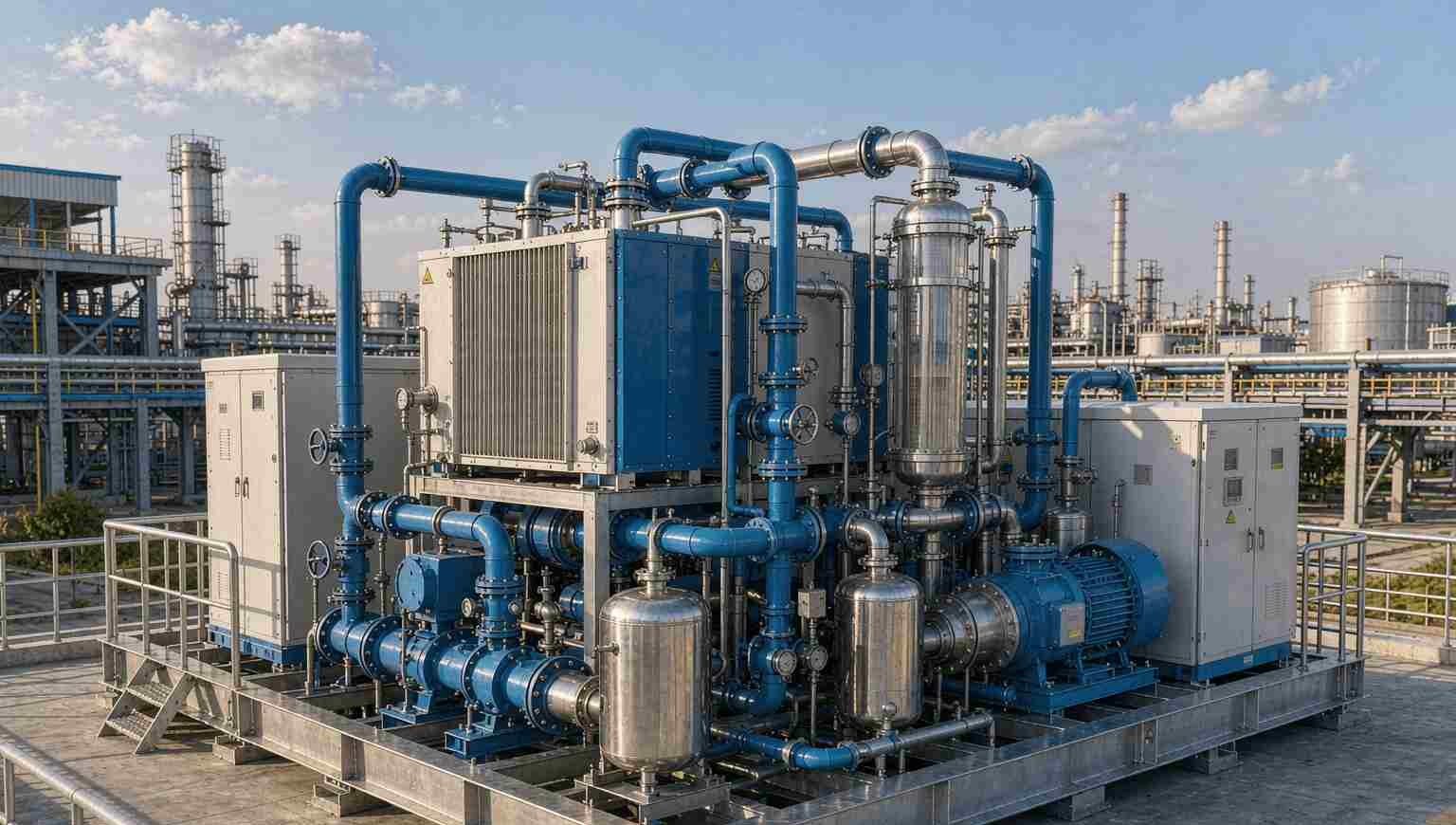
| Comparison dimension | Single pump configuration | Two pumps, one in operation and one as standby |
|---|---|---|
| Initial investment | lower | Add a pump and valve fittings |
| Failure impact | The entire system is down for maintenance | Switch to the standby pump to ensure uninterrupted operation |
| Land occupation and piping | Simple and compact | "Take up a bit more space, and add an extra set of pipeline valves." |
| Operation and maintenance focus | Keep a close eye on the single pump status | Main and standby rotation + regular test run of standby pump |
| Applicable scenarios | Small workload and quick response | High peak concentration and high cost of downtime |
| Failure risk | "Pump failure is like running naked." | Inadequate management will lead to the failure of the standby pump |
The daily management of dual pumps is more important than their configuration
I have seen many stations where the dual-pump configuration is very standard, but the standby pump has already broken down after two years - it has never been turned or maintained, and it cannot be used at all in case of an emergency. Therefore, the management focus of dual-pump stations is on three points: rotation (switching the main and standby pumps weekly or monthly to balance the wear and tear of the two pumps), test run (confirming the normal start-up, sound, and current of the standby pump every time it is switched), and record keeping (recording every switch and maintenance, so that the health status of both pumps is visible). If you are unsure whether to use dual pumps during the selection stage, you can provide the daily average oil delivery volume, diurnal load curve, and existing operation and maintenance conditions of the station to Luoyang Wohong Petrochemical Equipment Co., Ltd. They will provide a configuration comparison between single and dual pumps based on actual working conditions, including incremental investment and maintenance arrangements, for your decision-making.
Frequently Asked Questions
Should the dual pumps be switched automatically or manually?
For sites with personnel on duty and regular patrol inspections, manual switching is simpler in structure and has fewer failure points, often making it more reliable. For unattended sites or scenarios requiring non-stop machine sensing of faults, automatic switching combined with alarms is meaningful. In either case, the switching action should be regularly rehearsed, so as not to find out that it cannot be executed in case of a real failure.
Should the two pumps be of the same model or one large and one small?
Based on the principle of "guaranteed support for any single unit", the same model is the most hassle-free: spare parts are interchangeable, operating conditions are consistent, and there is no adaptation period for switching. The configuration of one large and one small unit is only meaningful when there is significant load fluctuation and the small pump alone can cover the low-load operating conditions. Generally, it is not necessary for stations to pursue this configuration.
We already have a single-pump station. Can we add a second one later?
Yes, but we need to verify three things: whether the processing capacity interface of the original system is reserved, whether there is space for additional installation of venues and pipelines, and how to integrate the control system into the switching logic. Before the renovation, it is much safer to provide the current status drawings to the equipment manufacturer for review, rather than making changes on-site while installing.
This article is compiled by Luoyang Wohong Petrochemical Equipment Co., Ltd. The company provides design and manufacturing, skid-mounted customization, installation and commissioning, as well as after-sales operation and maintenance services for three-time oil and gas recovery equipment to gas stations and oil depots. If you need on-site inspection or scheme configuration, please feel free to contact us for discussion.