The oil and gas recovery process at gas stations involves treating the oil and gas discharged from the tank breather valve: the volume is not large, but it occurs all day long, and the concentration fluctuates with temperature and the pace of oil receiving and dispensing. Using condensation alone cannot fully collect low-boiling-point components; using membranes alone places the entire load of high-concentration segments on the membranes, making it impossible to reduce the membrane area. The combined process of connecting the two stages complements each other's strengths and weaknesses, becoming the mainstream configuration in current gas station scenarios. This article clarifies the division of labor, connection methods, and configuration points of each stage, providing reference for site selection and daily operation and maintenance. The frequently asked questions at the end answer the most common questions during site selection.
What does the breathing oil vapor from a storage tank look like
The oil and gas discharged from the tank breather valve is a mixture of hydrocarbons and air: gasoline vapor predominantly consists of heavy hydrocarbons above C5, while low-boiling components such as butane and pentane are present in low concentrations but persist; the gas volume fluctuates with diurnal temperature differences and oil loading and unloading operations. There are two governance objectives - to maintain the emission concentration below the limit and to recover the oil gas and liquefy it back into the tank, which can be seen on paper. It is difficult for any single-level technology to achieve both objectives simultaneously: condensing the pressure to collect all low-boiling components would incur excessive temperature cost; while relying solely on membranes to handle high concentrations would increase investment.
What is the condensation stage for
The condensation stage is responsible for the bulk recovery. The mixed gas, after being pressurized by the compressor, enters the condensation unit, where the temperature is controlled between zero and minus ten degrees. Most of the heavy hydrocarbons above C5 are liquefied into liquid gasoline, which is directly returned to the storage tank. This stage is characterized by large recovery volume, direct liquid output, and visible benefits; however, its weakness lies in the low concentration range - the remaining light components such as butane in the tail gas. If the temperature is further lowered, energy consumption rises sharply, making it economically unviable. Therefore, the condensation temperature is set at the point where the bulk recovery is achieved and then stopped, leaving the rest to the next stage.
What is membrane grade for
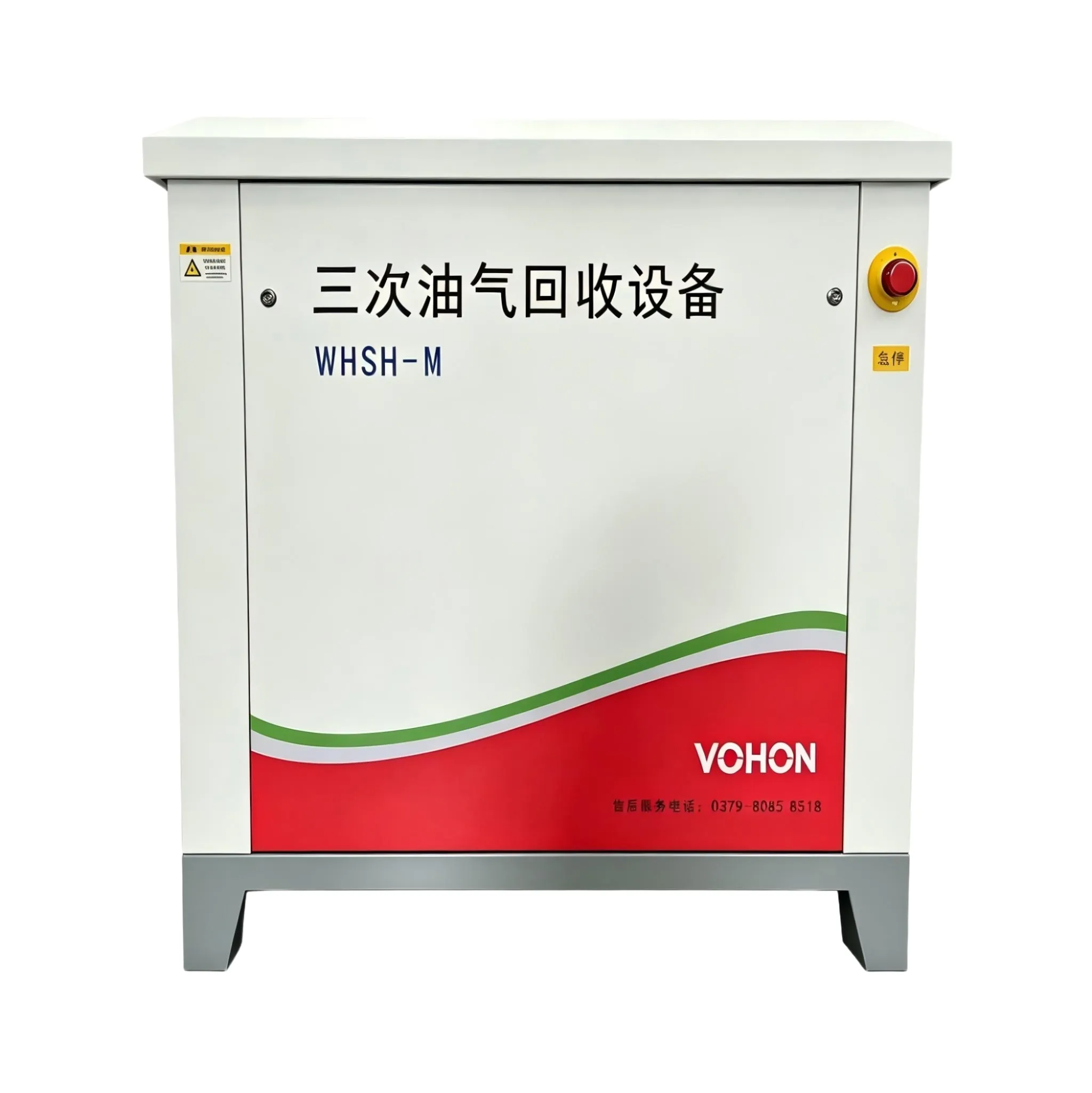
The membrane level is responsible for quality control. The uncondensed tail gas enters the membrane separation unit, where the pressure difference between the feed side pressurization and the permeate side vacuum pumping drives the oil vapor to preferentially permeate through the membrane to form an enriched gas, which is returned to the compressor inlet for recycling and treatment. The retained air has a very low hydrocarbon concentration and meets emission standards. The rubber-like separation layer has high solubility for organic molecules, and the oil vapor permeates through the membrane at a speed tens of times faster than air. The membrane is a non-porous, dense structure, eliminating the risk of pore blockage. There is no electrostatic accumulation during operation, providing a substantial safety advantage in scenarios with dense personnel traffic, such as gas stations.
How to connect the two levels
A circulating pipeline lies between the two stages: the enriched gas from the membrane is not discharged, but sent back to the compressor inlet for another round of condensation. The residual organic matter is repeatedly captured, with an overall recovery rate of over 99% and an emission concentration stabilized at less than 10 grams per cubic meter. The key to the connection lies in the working conditions before the membrane: the filtration and dehumidification section protects the separation layer, and the buffer configuration stabilizes the gas volume fluctuation. If these two aspects are done well, the subsequent stage will be worry-free. Condensation reduces the burden on the membrane, and the membrane supports condensation, with the division of labor between the two stages not conflicting.
Overview of two-tier configuration
| Grade/Level | task | Configuration considerations |
|---|---|---|
| Collecting boost pressure | Pressure boosting of tank breathing gas manifold | Leave a margin based on peak gas volume |
| Condensation stage | Collect heavy hydrocarbons with carbon number above C5 | Temperature range from zero to minus ten degrees |
| Membrane grade | Enrichment of low boiling point components for quality control | Pressure difference-driven with preprocessing |
| Circulating pipeline | Enriched gas return inlet | Closed circuit without external discharge |
| Emission side | Trapped air meets the standard | Concentration detection recorded in the ledger |
| security configuration | Explosion protection and static electricity management | No electrostatic accumulation in membrane components |
Attention to daily operation
- The pre-membrane filter material is replaced based on pressure difference to prevent liquid droplets and particles from reaching the membrane surface;
- Record the pressure difference and vacuum degree daily, and plot the trend on a weekly basis;
- Include the inspection of vacuum pump oil level and temperature rise in the routine check, and maintain it according to the regulations;
- The emission outlets are inspected based on frequency, and the data is recorded in a ledger to observe trends;
- Incorporate explosion-proof zoning and electrostatic grounding inspections into the monthly checklist;
- The recycling volume and sales volume are reconciled on a monthly basis, and any anomalies are first investigated at the collection end.
Frequently Asked Questions
Is the investment for condensation and film coating high?
The two-stage configuration places the burden of each stage within an appropriate range: condensation does not have to be carried out at a deep cold temperature, and the membrane area does not have to bear high concentration. The overall investment is more reasonable than that of a single-stage system, and the recovered oil products themselves have economic value.
Is it okay to only apply a film without condensation?
Yes, but it depends on the concentration: feeding with high concentration and large flow rate will double the membrane area, making the investment less cost-effective. Collecting the majority of the condensation first and using the membrane to control at the low concentration stage is the most cost-effective approach for most stations.
Why should the enriched gas be returned to the compressor inlet?
The enriched gas has a high concentration and small total volume. Returning it to the inlet for recycling not only prevents it from being discharged but also enhances the overall recovery rate. After forming a closed loop, the emission side only contains air that meets standards, making it cost-effective for both environmental protection and economy.
This article is compiled by Luoyang Wohong Petrochemical Equipment Co., Ltd. The company provides design and manufacturing, skid-mounted customization, installation and commissioning, as well as after-sales operation and maintenance services for three-time oil and gas recovery equipment to gas stations and oil depots. If you need on-site inspection or scheme configuration, please feel free to contact us for discussion.