What is tertiary vapor recovery? Straight answer: It is a set of vapor emission treatment device installed at the end of the storage tank breather pipe at gas stations. It treats the vapor emitted from the tank's "breathing" before discharging it, and is called a vapor emission treatment device in the industry. It is not three models of the same device as primary and secondary recovery, but three links in the recovery chain: primary recovery pipe for unloading oil, secondary recovery pipe for refueling, and tertiary recovery pipe for tank breathing. They differ in their objects, locations, and processes. Many owners confuse the three, which can easily lead to losses during model selection and acceptance inspection. This article clarifies the differences between the three and the composition of tertiary recovery.
What does each of the three links manage
Primary recovery addresses the unloading process: When the tanker unloads oil into the buried tank, the gas phase inside the tank is pressed back into the tanker for unified treatment upon return to the factory. Secondary recovery addresses the refueling process: The fuel nozzle is equipped with a recovery circuit, and the oil vapor displaced from the vehicle's fuel tank returns to the buried tank via the return pipe, with the gas-to-liquid ratio generally controlled between 1.0 and 1.2. Tertiary recovery addresses the storage process: The evaporation of oil products in the tank and the temperature difference between day and night cause the pressure inside the tank to rise. When the pressure reaches the set value (typically around +150Pa), it is vented through the breather valve. The tertiary recovery device controls this breather pipe, and only discharges the gas when it meets emission standards. These three stages operate independently, yet are linked together by the buried tank as a "transfer station" to form a chain.
Why can't we save by recycling three times
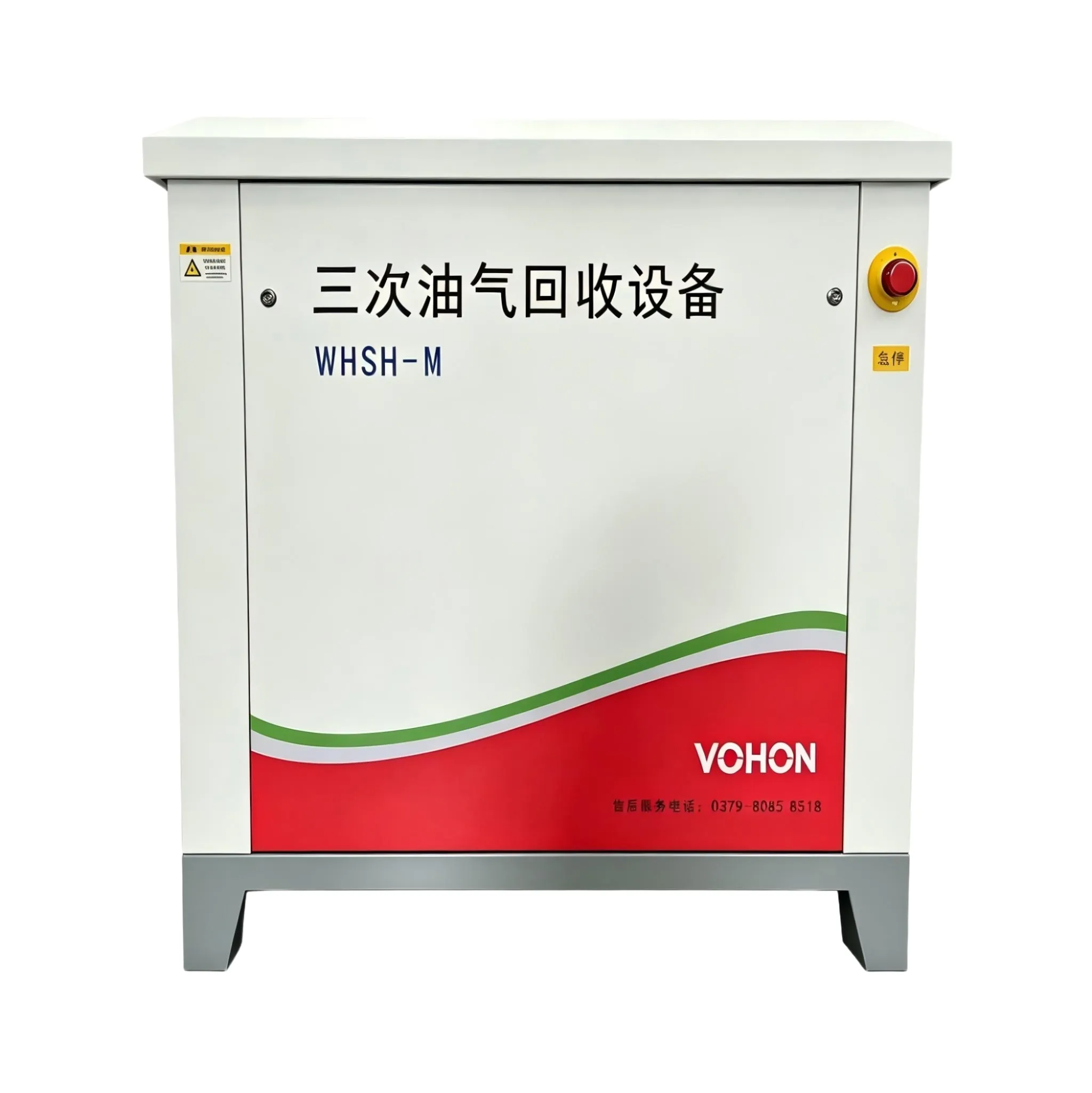
The primary and secondary recovery processes capture the majority of the emissions, and while the remaining breathing emissions may seem small in quantity, they represent a long-term and continuous outlet for on-site oil and gas emissions. The temperature drops at night and rises during the day, causing the tank to breathe continuously. After the unloading and gas return process, the pressure inside the tank increases, leading to periodic increases in breathing emissions. In environmental inspections, issues such as excessive emission concentrations and direct emissions from breathing valves often arise due to the absence or non-operation of tertiary recovery systems. If one segment of the tertiary chain is missing, the oil and gas collected by the first two segments will still escape through the breathing valve, rendering the efforts in vain.
What process is used for tertiary recovery
The mainstream approach involves a combination of condensation and membrane separation: the breathing gas first undergoes condensation to turn the high-concentration segment into liquid oil for recovery, while the uncondensed low-concentration tail gas enters the membrane separation unit. Organic components are preferentially enriched through the membrane, and the enriched gas is returned to the condensation inlet for recycling, while the purified gas on the retentate side is discharged after meeting emission standards. Single-stage membrane separation alone often struggles to directly meet emission limit requirements, and only through a combined process can the emission concentration be stably reduced to less than 25 grams per cubic meter, which is also the emission limit specified in the current air pollutant emission standards for gas stations. Adsorption processes are also applied in small-volume gas stations, each with its own applicable boundaries.
Provide the owner with a consistent memory: primary recovery is "during oil unloading", secondary recovery is "during oil filling", and tertiary recovery is "also during non-oil filling and non-oil unloading". Only when all three stages are fully equipped and operating normally can the oil and gas in the station be truly controlled.
Reference for tertiary recycling division of labor
| link | Recycling objects | Common forms |
|---|---|---|
| One-time recycling | Oil unloading and oil vapor replacement | Tanker gas phase carryback |
| Secondary recycling | Refueling tank replacement gas | Recovering gun and return tube |
| Three-time recycling | Storage tank breathing emissions | Respiratory tube end treatment device |
| Startup method | Can pressure triggering | Set pressure and automatically put into operation |
| Mainstream process | Condensation and film-forming combination | Enriched gas recycling |
| Acceptance indicators | Emission concentration limit | According to the current national standard |
Model selection reminder
- For the third recovery, the type selection is based on the peak respiratory emission volume, with a margin reserved for operating conditions;
- Conduct a linkage verification between the start-stop pressure setting of the device and the fixed value of the breather valve;
- The emission concentration shall be inspected and accepted according to the local emission limit standards;
- During the oil unloading process, the equipment should remain operational and be included in the operating procedures;
- The height of the emission outlet and the position of the sampling port shall be reserved according to the specifications;
- The new station should be fully equipped during the design phase, while for the renovated station, the breathing circuits should be surveyed first.
Frequently Asked Questions
Which stations need to install three recycling systems?
Implementing the regulatory standards based on territorial jurisdiction, most regions have set requirements for annual sales volume or gasoline filling stations in key areas; newly constructed stations are generally required to be fully equipped during the design phase, and existing stations are required to comply with rectification notices and local deadlines.
Does the tertiary recovery device need to be manned at ordinary times?
The device starts and stops automatically according to tank pressure, and routine inspection is the main focus: checking the operating status, pressure curve, and status of the discharge outlet; for sites equipped with remote monitoring, any abnormalities will be actively pushed, eliminating the need for dedicated personnel to monitor.
Is it okay to only conduct three rounds of recycling instead of one or two rounds?
不行。三级回收的对象不同,罐内油气不靠前两级回收,三次回收的处理负荷会超设计工况;三级配套、逐级减负,才是完整的治理链条。
This article is compiled by Luoyang Wohong Petrochemical Equipment Co., Ltd. The company provides design and manufacturing, skid-mounted customization, installation and commissioning, as well as after-sales operation and maintenance services for three-time oil and gas recovery equipment to gas stations and oil depots. If you need on-site inspection or scheme configuration, please feel free to contact us for discussion.