In recent years, the management of oil and gas recovery at gas stations and oil depots has shifted from "equipment installation is considered compliant" to "operational data needs to be clear and transparent". Primary and secondary oil and gas recovery address the closed recovery during oil unloading and refueling processes, while tertiary oil and gas recovery equipment is responsible for handling the rich oil and gas in the tank breathing and return gas paths. In many regions, the operational status, emission concentration, and equipment start-stop records of the oil and gas recovery system are gradually being incorporated into the scope of online monitoring and data management. For owners, the configuration approach needs to change: equipment should not only be installed, but also be connected to the monitoring system and generate operational data.
From "installation" to "achieving results": the shift in management focus
In the past few years, the focus of construction was on coverage: completing the recovery pipelines for each link, including oil unloading, storage, and refueling. Now, the focus of management has clearly shifted to operational quality - whether the emission concentration is stable, whether the recovery equipment is actually operating, and whether operational parameters such as gas-liquid ratio are within a reasonable range, all require continuous data support. This means that the three-stage oil and gas recovery equipment is no longer an isolated mechanical device, but rather a part of the entire oil and gas recovery system where data can be traced and status can be controlled.
Three manifestations of refined management
- Data traceability: Equipment start-stop, fault alarms, and emission concentrations must be recorded, allowing for easy access and traceability at any time;
- Integrated operation: The recycling equipment starts and stops in conjunction with the operational conditions of the oil unloading and storage tanks, rather than relying on manual record-keeping for startup;
- Operational and maintenance prepositioning: Inspection and maintenance are arranged according to operational data, and any indicator that deviates will be traced back to the corresponding link.
How to integrate the three-time oil and gas recovery with online monitoring
The logic of the linkage is not complicated: set up detection points at the inlet and outlet of the oil and gas recovery equipment and the condensate circuit for three times, connect temperature, pressure, and concentration signals to the monitoring host in the station, and then upload or archive them according to local management requirements. Reserve standard signal interfaces on the equipment side, and perform point verification on the monitoring side. The docking of the two ends is determined during the design stage to avoid dismantling and rewiring after installation.
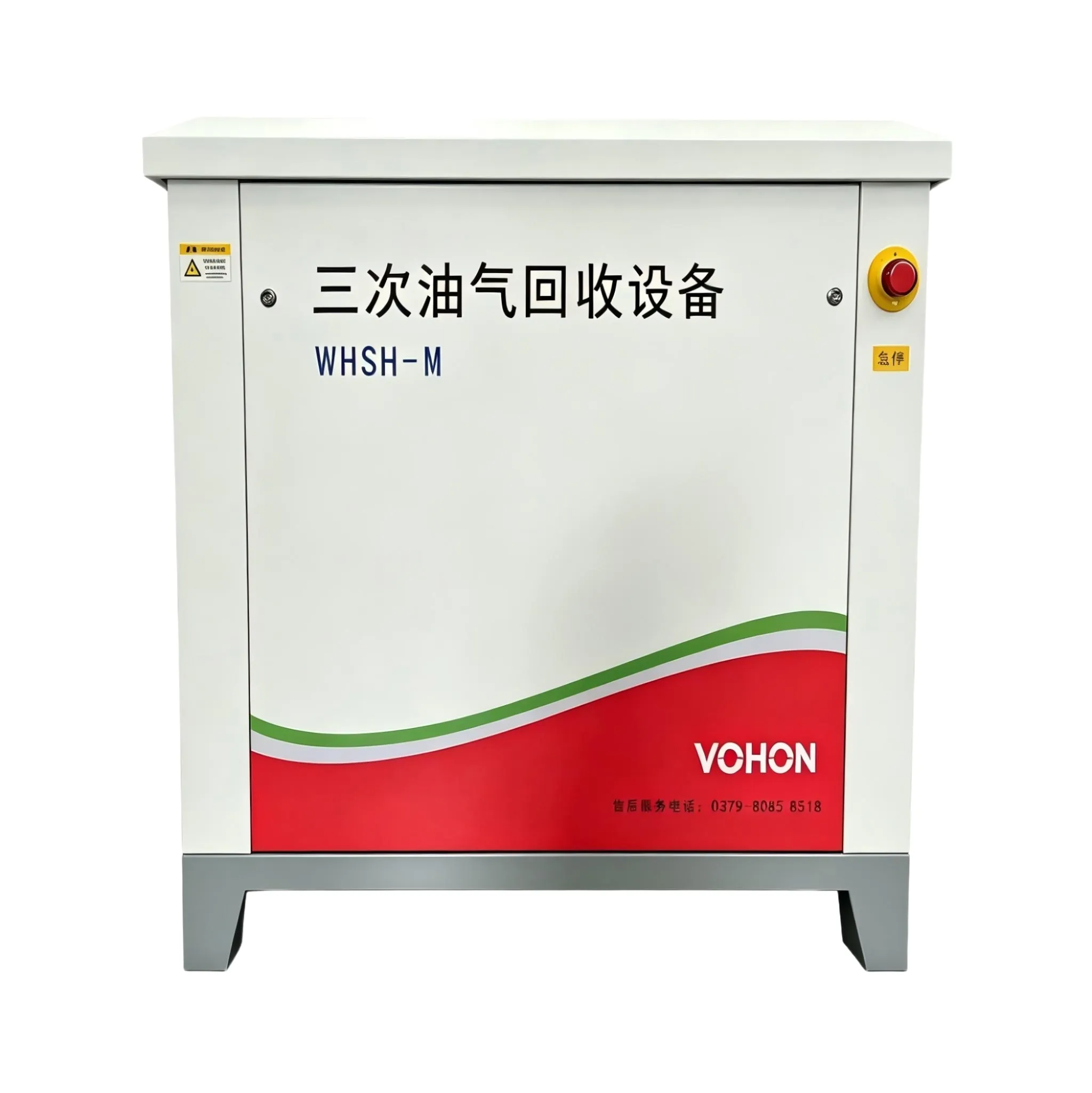
Implementation steps of linkage configuration
- Organize monitoring requirements: Confirm local requirements for the locations and data items of online monitoring for oil and gas recovery;
- When selecting equipment, signal output is listed as a hard criterion, with four types of signals: concentration, temperature, pressure, and operating status, all of which must be available;
- During the design phase, unify the routing of pipelines and cables, and arrange the detection points in locations that are convenient for maintenance;
- During debugging, verify the accuracy of data point by point and calibrate the remote transmission values using on-site measured values;
- Establish an operational ledger to reconcile monitoring data with recycling volumes and oil product losses, ensuring that data truly serves management purposes.
Comparison of configuration ideas between newly established stations and existing stations
| Comparison item | Newly established station | Renovation of campsite |
|---|---|---|
| design phase | Integrated planning of recycling equipment and monitoring points | Based on the current situation survey, priority should be given to utilizing existing resources |
| Construction method | Construction is synchronized with the construction of the station, ensuring that the pipelines are in place at one time | The skid-mounted equipment is quickly positioned and construction is carried out during business breaks |
| Docking work | The monitoring system shall be submitted for inspection together with the station | Complete the signal lines and checkpoints, and verify them point by point |
| Focus on the key points | Reserved expansion and maintenance space | Existing pipeline leak verification and replacement of old interfaces |
Suggestions for implementation for the property owner
During the planning phase of a new station, the tertiary oil and gas recovery equipment and monitoring points should be designed integratively, ensuring that civil engineering and pipelines are in place at once to minimize costs. In the renovation of existing stations, priority should be given to skid-mounted equipment, which has a short construction window and minimal impact on business operations. During the renovation, the tightness and slope direction of existing pipelines should be checked simultaneously, and old interfaces should be replaced as necessary. Whether it's a new construction or renovation, the acceptance criteria are suggested to be set at two points: emission concentration meets local management requirements, and monitoring data is continuous, complete, and traceable. By achieving these two points, no matter how detailed the management requirements are, the station will be able to handle them with ease.
Frequently Asked Questions
The old station has no reserved monitoring pipelines. Can it still be renovated?
可以。撬装设备自带检测点与信号接口,改造时沿现有管线路由敷设信号线,施工窗口一般几天内完成,不影响正常营业。
Who is responsible for maintaining the online monitoring data?
The detection points and signal transmission are jointly ensured by both the equipment and the monitoring system. Daily inspections include checking the integrity of data, and in case of anomalies, investigations are conducted separately based on the equipment and the monitoring system.
Will the monitoring system alarm during the three shutdown periods of the oil and gas recovery equipment?
Under the integrated design, equipment downtime and fault status will be recorded on the monitoring terminal, which is a normal management practice; downtime for maintenance should be reported in advance and recorded properly.
This article is compiled by Luoyang Wohong Petrochemical Equipment Co., Ltd. The company provides design and manufacturing, skid-mounted customization, installation and commissioning, as well as after-sales operation and maintenance services for three-time oil and gas recovery equipment to gas stations and oil depots. If you need on-site inspection or scheme configuration, please feel free to contact us for discussion.